
The Ultimate Guide to Using Benjamin Franklin's 13 Virtues Journal for Success and Self-Mastery
By The Modern Gentleman's Code

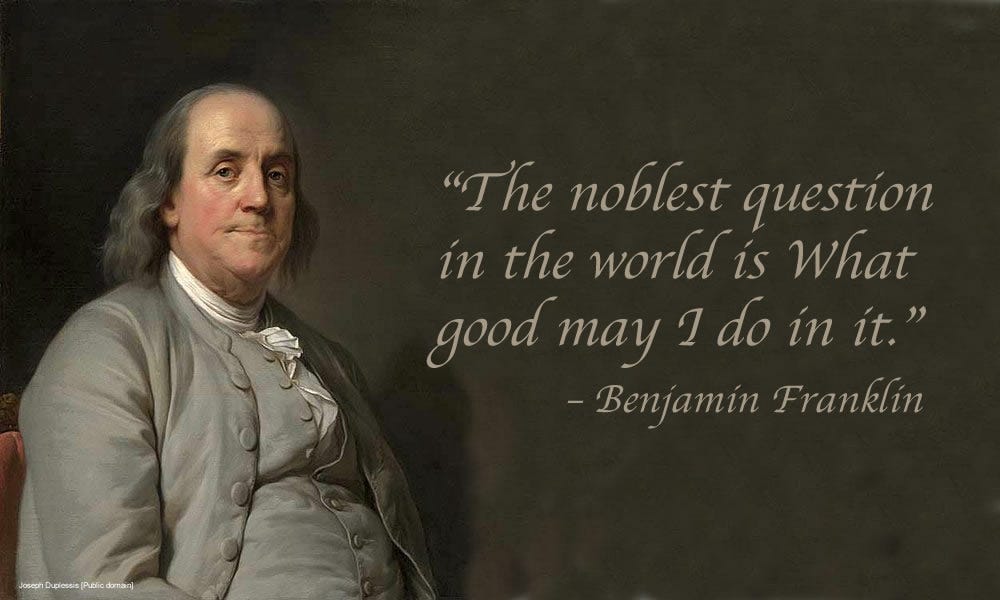
Let’s be honest: nobody ever wakes up fully formed, brilliant, and respected. That person is a myth; or a Ben Franklin experiment gone right. You can start getting close today. Franklin didn’t just stumble through life inventing bifocals; he charted himself with 13 virtues, testing, tracking, failing, adjusting. And that’s exactly the mindset you need if you want to master yourself and make people sit up, notice, and respect you.
But let’s skip the moralizing: these virtues aren’t about being “good,” they are about becoming a pillar of your community and the man you deserve to be. You wouldn’t leave your professional skills to chance, hoping they somehow develop on their own, you hone them deliberately, the same principle applies to your character. If you do not, you will end up with nothing more than the ideas you like, rather than the values you actually live by. Here’s how to channel Benjamin Franklin, without living like an 18th-century aesthetic.
Benjamin Franklin tracked his progress by placing a cross at the end of each day next to the virtue he fell short on.
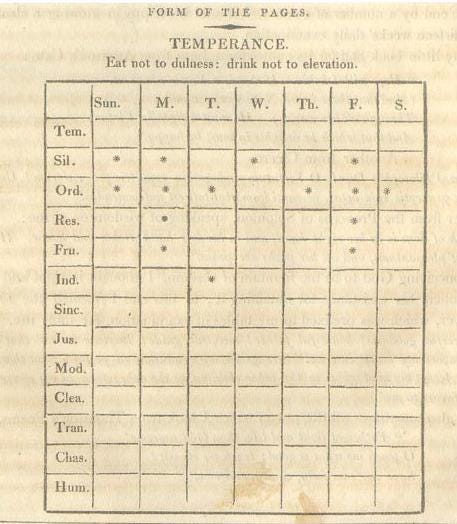
By doing this, he kept the virtues at the forefront of his mind throughout the day, making it less likely he would act unvirtuously out of instinct. At the bottom of the article, I’ll also include a free, printable action plan so you can track your progress in your values, just like Benjamin Franklin did. Here are Benjamin Franklin’s 13 virtues:
1. Temperance
“Eat not to dullness; drink not to elevation.”
Franklin tracked what made him sluggish and cut it ruthlessly. Temperance, as taught by Benjamin Franklin, can be practiced by creating small rules that prevent excess. Eat at regular times and stop when you feel about 80% full, not stuffed, is a habit known as “Hara Hachi Bu,” traditionally practiced by many elders in Okinawa, one of the world’s Blue Zone regions, famous for its high number of centenarians. Use smaller plates, drink a glass of water before meals, and wait a few minutes before taking more food to avoid overeating. Limit alcohol or sweets and start intermittent fasting, which is eating only within a set daily window and fasting the rest of the time. For example, a 16:8 schedule means eating for 8 hours and fasting for 16, which is easier than it seems because sleeping counts as fasting, so often you just need to skip breakfast.
Start small, and then level up as you go. Studies show that setting modest, achievable wins, and gradually scaling them, distinguishes the people who stick with new habits from those who abandon them.
2. Silence
“Speak not but what may benefit others or yourself; avoid trifling conversation.”
“Silence is one of the great arts of conversation,” as said by Marcus Tullius Cicero, highlights that knowing when not to speak can be as powerful as knowing what to say. By pausing, listening carefully, and choosing words deliberately, we make our contributions more meaningful and avoid empty or harmful chatter. Silence also gives space for reflection, deepens understanding, and shows respect for others’ thoughts, turning conversation into a thoughtful exchange rather than a flood of noise. Only the most insecure look to fill every silent gap with sound.
3. Order
“Let all your things have their places; let each part of your business have its time.”
Order can be practiced by organizing both your physical space and daily schedule. Start by assigning a specific place for every item you use regularly, from keys and documents to tools and gadgets, so you never waste time searching for them. Plan your day by blocking time for tasks, prioritizing important work first, and setting clear start and end times for each activity. Studies show that keeping your environment organized (following the principle of “clean room, clean mind”) can improve focus, reduce stress, and increase productivity. A tidy space helps the brain process information more efficiently, prevents decision fatigue, and supports better time management, demonstrating that the physical order of your surroundings directly impacts mental clarity and effectiveness.

4. Resolution
“Resolve to perform what you ought; perform without fail what you resolve.”
The virtue of Resolution becomes far more achievable when paired with the concept of flow state, discussed by Cal Newport. Newport emphasizes deep work, which means blocking distractions, dedicating uninterrupted time to a meaningful task, and committing to seeing it through, focusing fully on a task until it is completed. By resolving to start and finish tasks without multitasking, you enter a flow state where productivity and focus peak, making it easier to perform without fail what you resolve and achieve high-quality results efficiently. Pick one thing and finish it completely, the habit of finishing builds trust in yourself the foundation of mastery, we are very good at being dependable for other people, but have a hard time being dependable for ourselves.
5. Frugality
“Make no expense but to do good to others or yourself; i.e., waste nothing.”
Frugality is about using resources wisely and avoiding waste. Practically, this means tracking your spending, buying only what is necessary or truly valuable, and finding ways to repurpose or reuse items instead of discarding them. For example, you might meal-plan to avoid food waste, invest in high-quality, tailored clothing that can last decades and be repaired instead of replaced by fast fashion, since a few quality pieces are worth far more than hundreds of disposable items. You can also share tools and resources with neighbors, friends, and family, rather than buying duplicates. Frugality also applies to time and energy: avoid unproductive activities that drain focus or money, and instead invest in things that genuinely improve your life or strengthen your bonds with loved ones. Spend on experiences that create lasting memories rather than material clutter. By practicing frugality, you cultivate financial discipline, efficiency, and a mindset that values purpose over excess.
6. Industry
“Lose no time; be always employ’d in something useful; cut off all unnecessary actions.”
Franklin worked tirelessly and he was strategic about it. Block time for your highest-leverage activity, and guard it like a lion. No distractions. No half-effort. The difference between someone great and someone mediocre is almost always consistent action, rather than pure talent.
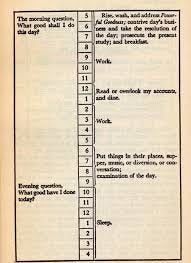
Benjamin Franklin’s daily schedule
7. Sincerity
“Use no hurtful deceit; think innocently and justly, and, if you speak, speak accordingly.”
Sincerity is about being honest in thought, word, and intention. In practice, this means speaking truthfully, avoiding exaggeration or manipulation, and aligning your words with your genuine beliefs. Before speaking, ask yourself whether what you say is true, fair, and necessary. Avoid gossip or misleading statements, and communicate clearly and respectfully even when discussing difficult matters. By practicing sincerity, you build trust, integrity, and strong relationships, because others know that your words reflect your true thoughts and intentions.
8. Justice
“Wrong none by doing injuries, or omitting the benefits that are your duty.”
The virtue of Justice means treating others fairly and fulfilling your responsibilities toward them. In practice, this means avoiding actions that harm others, keeping your promises, and actively helping when it is your duty or within your ability. Justice is not only about avoiding wrongdoing but also about doing the good that you owe to others; by being honest in business, showing up for your duties in the community, whether that’s cheering on a friend at their amateur stand-up show or calling your grandma, who’s been feeling lonely, once a week.
9. Moderation
“Avoid extremes; forbear resenting injuries so much as you think they deserve.”
Moderation is about maintaining balance in emotions, opinions, and actions. In practice, this means not reacting impulsively or excessively, especially when you feel wronged. Instead of holding strong resentment or seeking revenge, pause, reflect, and respond calmly. By keeping emotions and reactions in balance, you preserve clear judgment, inner peace, and healthier relationships.
10. Cleanliness
“Tolerate no uncleanliness in body, cloaths, or habitation.”
Your brain cannot operate in a chaotic environment. Tidy spaces, organized workflows, and digital hygiene are invisible power. Even ten minutes clearing your desk daily is like sharpening a knife. Everything flows easier; decisions feel more simple to make; your presence feels sharper. Clean and organized environment=organized mind.

11. Tranquility
“Be not disturbed at trifles, or at accidents common or unavoidable.”
It is about maintaining calm and peace of mind despite small annoyances or inevitable setbacks. In practice, this means not overreacting to minor inconveniences such as delays, mistakes, or things outside your control. Instead, accept that small problems are part of life and focus your energy on what truly matters. By practicing tranquility, you develop emotional stability, patience, and a clearer mind, allowing you to respond to life’s challenges with composure rather than frustration.
“WHEN YOU WAKE UP IN THE MORNING, TELL YOURSELF: THE PEOPLE I DEAL WITH TODAY WILL BE MEDDLING, UNGRATEFUL, ARROGANT, DISHONEST, JEALOUS, AND SURLY. THEY ARE LIKE THIS BECAUSE THEY CAN’T TELL GOOD FROM EVIL.” - MARCUS AURELIUS, MEDITATIONS BOOK 2.1
12. Chastity
“Rarely use venery but for health or offspring, never to dullness, weakness, or the injury of your own or another’s peace or reputation.”
You shouldn’t be a slave to your sexual desires, losing control over your arousal to the point that it harms others or yourself is destructive and will catch up with you sooner or later. Lack of restraint can destroy, not only reputations, but lives and whole communities, as we’ve seen with figures like Jeffrey Epstein and (now former Prince) Andrew Mountbatten Windsor. Practicing self-control in this area protects your integrity, relationships, and future. And most importantly, it protects the most innocent and vulnerable in our communities from being exploited by the selfish desires of those who are stronger than them.
13. Humility
“Imitate Jesus and Socrates.”
Franklin admired Socrates and Jesus, and pointed to them as role models. Humility isn’t about putting yourself down, it’s about seeing clearly where you excel and where you don’t, and acting without arrogance. It is about recognizing your limits, remaining open to learning, and not placing yourself above others. In practice, this means listening more than you speak, admitting when you are wrong, and giving credit to others for their contributions. Humility encourages a mindset of continuous learning and respect, reminding us that wisdom often begins with acknowledging how much we still have to learn. Admit mistakes openly, and don’t take credit for things that aren’t yours. The more secure you are in your humility, the more influence, respect, and trust you naturally command. Humility shows confidence without the need to dominate.
“WHEN JESUS NOTICED HOW THE GUESTS CHOSE THE PLACES OF HONOR, HE TOLD THEM A PARABLE: ‘WHEN YOU ARE INVITED TO A WEDDING BANQUET, DO NOT SIT IN THE PLACE OF HONOR, IN CASE SOMEONE MORE DISTINGUISHED THAN YOU HAS BEEN INVITED. THEN THE HOST WHO INVITED BOTH OF YOU WILL COME AND TELL YOU, “GIVE THIS MAN YOUR SEAT.” AND IN HUMILIATION, YOU WILL HAVE TO TAKE THE LAST PLACE.’ BUT WHEN YOU ARE INVITED, GO AND SIT IN THE LAST PLACE, SO THAT YOUR HOST WILL COME AND TELL YOU, ‘FRIEND, MOVE UP TO A BETTER PLACE.’ THEN YOU WILL BE HONORED IN FRONT OF EVERYONE AT THE TABLE WITH YOU. FOR EVERYONE WHO EXALTS HIMSELF WILL BE HUMBLED, AND THE ONE WHO HUMBLES HIMSELF WILL BE EXALTED.’”

The 13 virtues are there to guide you on your journey to become a better man for your community, a pillar of strength. Franklin didn’t aim just for perfection; he aimed for self-mastery. That’s why we still talk about him. As I highlighted at the beginning of the article Benjamin Franklin tracked his progress by placing a mark at the end of each day next to the virtue he fell short on. By doing this, he kept the virtues at the forefront of his mind throughout the day, making it less likely he would act unvirtuously out of instinct. You can do the same, I’ve prepared a free, printable action plan that lets you track your progress just like Benjamin Franklin did. Don’t forget to subscribe, I’d be absolutely overjoyed! It would help me immensely in making this little corner of the world the very best it can be. Don’t forget to take it one step at a time; every day is a new beginning, cheers!
Your free, printable virtue action plan:

SUBSCRIBE HERE:
This is peak Non fictional content. You should be a star writer brother.
Great theme for Substack. Franklin’s virtue journal is fascinating because it treats character like a craft rather than a fixed trait.
Instead of assuming goodness appears naturally, he approached virtue as something practiced daily. That idea feels surprisingly modern. Tracking habits forces awareness, and awareness slowly shapes behavior.
The deeper lesson may not be perfection but reflection.
When a person observes their actions honestly, improvement becomes possible.
Self mastery begins not with grand ideals but with the quiet discipline of noticing where we fall short and choosing, day by day, to adjust.
I really enjoyed this article